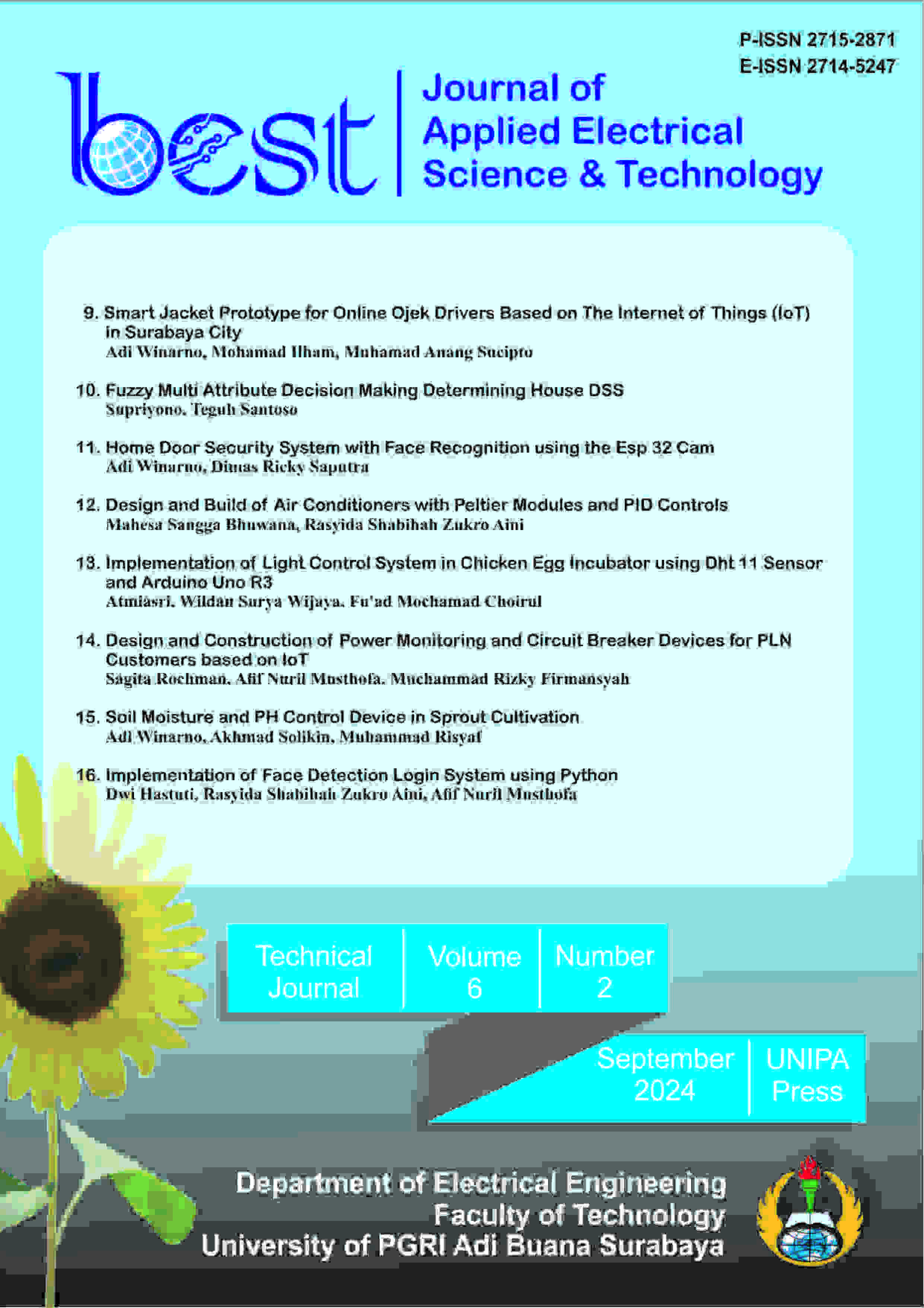
Design and Build of Air Conditioners with Peltier Modules and PID Controls
DOI:
https://doi.org/10.36456/best.vol6.no2.9714Keywords:
PID Control, Temperature Sensor, Thermoelectric PeltierAbstract
Air conditioners are among the technologies that have been increasingly common, as time has gone on, from personal comfort to room comfort. A multi-story building is one location that requires air conditioning. This is because the structure's air pressure will rise until a certain level, making the temperature too low, so air conditioning is necessary to maintain a comfortable temperature. Similarly, in tropical areas where the temperature exceeds what is reasonably comfortable. However, the current air conditioner technology has the potential to harm the environment. Since Freon, which is used in it, can pass through the ozone layer. Eventually, global warming will happen and the world will get hotter. The SHT21 sensor is the kind of sensor that will be utilized in this final project since it has strong and steady chemical resistance over time and uses the I2C interface. This type of sensor is also capable of being utilized as a calibrated ambient temperature sensor, with a digital output form already comprised. This sensor will enable us to create a PID system with feedback that monitors the temperature produced by the Peltier module along with reacting to controlled PID by delivering PWM into the driver, then subsequently transmits the signal to the Peltier module for monitoring. When the duty cycle is 100 percent or the PWM value is set to 255, the Peltier module generates a 12-volt voltage at its best. When duty cycle 0 percent or PWM value 0 is selected, the module stops functioning. It is anticipated that this system will advance toward a Freon-free air conditioning system.
References
Ronald, Umboh, "Perancangan Alat Pendinginan Portable Menggunakan Elemen Peltier", Manado (2012).
Hodes, M, “Optimal Pellet Geometries for Thermoelectric Refrigeration,” IEEE Transactions on Components and Packaging Technologies, vol. 30, issue 1, (2007) 50-58.
Azridjal Aziz, "Aplikasi Modul Pendingin Termoelektrik Sebagai Media Pendingin Kotak Minuman," ResearchGate, (2015).
Fukutani, K., Shakouri, Ali, “Design of Bulk Thermoelectric Modules for Integrated Circuit Thermal Management,” IEEE
Transactions on Components and Packaging Technologies, vol. 29, issue 4, (2006) 750-757.
M D Kamrul Russel, “A Hybrid Thermoelectric Cooler Thermal Management System For Electronic Packaging,” Master of Applied Science Thesis, McMaster University, Ontario, Canada, (2011).
Hebei I.T Co., LTd., "Thermoelectric Cooler TEC1-12706,” Shanghai, (2017).
Agung Andri Kurniawan, Muhammad Rivai, Fajar Budiman, “Sistem Pemandu Pendaratan pada Balon Udara Berbasis Pengolahan Citra dan Kendali PID”, Jurnal Teknik ITS, Vol. 5, No. 2, (2016), pp. A179-184.
Irwan Juniar Sasongko, Muhammad Rivai, “Mesin Pemanggang Biji Kopi dengan Suhu Terkendali Menggunakan Arduino Due”, Jurnal Teknik ITS, Vol. 7, No. 2, (2018), pp. F239-244
R. Simons, "Effect of Improved Thermoelectric ZTs on Electronic Coolability," in ElectronicsCooling Vol. 6, No. 2, (2000).
Arista Ainurrohmah, Muhammad Rivai, Tasripan, “Kontrol Laju Alir Pompa Air Berpenggerak Brushless DC Motor”, Jurnal Teknik ITS, Vol. 7, No. 2, (2018), pp. F269-274
R. Simons, "Effect of Improved Thermoelectric ZTs on Electronic Module Coolability," in ElectronicsCooling, Vol. 12, No. 4, (2006).
Muhammad Rivai, Suwito, Peter Chondro, Shanq-Jang Ruan, “Design and Implementation of a Submerged Capacitive Sensor in PID Controller to Regulate the Concentration of Non-Denatured Ethyl Alcohol”, International Seminar on Intelligent Technology and Its Application, (2015), pp. 45-50
Khairunnisa Nurhandayani, Muhammad Rivai, “Sistem Kontrol Pengering Makanan Berbasis LED Inframerah”, Jurnal Teknik ITS, Vol. 7, No. 2, (2018), pp. A355-361
Downloads
Published
Issue
Section
License
Copyright (c) 2024 Mahesa Sangga Bhuwana, Rasyida Shabihah Zukro Aini

This work is licensed under a Creative Commons Attribution-ShareAlike 4.0 International License.