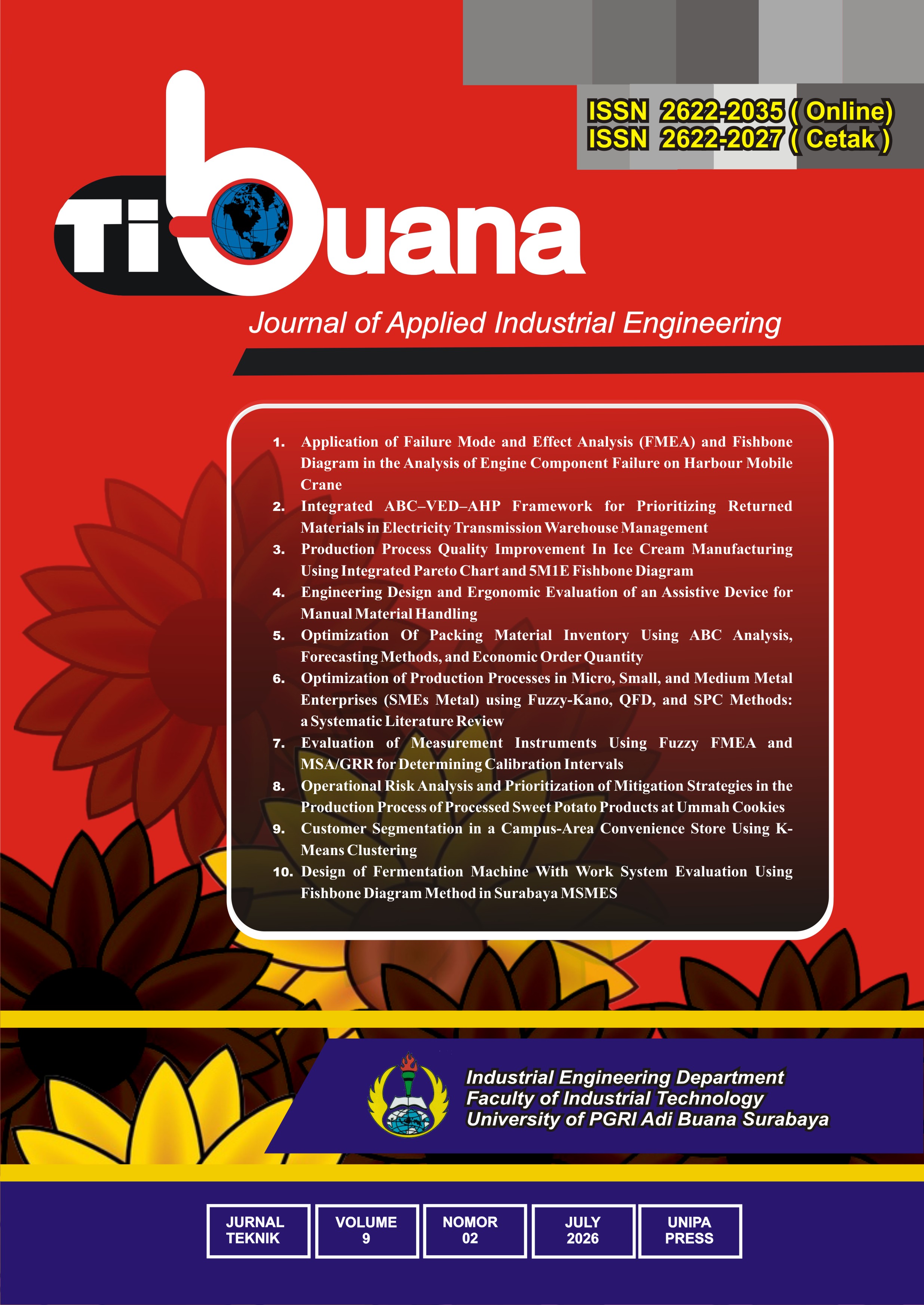
Engineering Design and Ergonomic Evaluation of an Assistive Device for Manual Material Handling
DOI:
https://doi.org/10.36456/tibuana.9.02.11149Keywords:
Assistive device , Ergonomic risk assessment, Manual material handling, Revised NIOSH lifting equationAbstract
Manual material handling (MMH) remains a major contributor to work-related musculoskeletal disorders in manufacturing environments. This study proposes and evaluates an assistive device for box panel handling aimed at reducing ergonomic risk during lifting and transport operations at PT. XYZ. A case-study approach was employed using multiple ergonomic assessment methods, including the Nordic Body Map (NBM), Rapid Entire Body Assessment (REBA), the Revised NIOSH Lifting Equation (RNLE), and the Snook Tables. Baseline results indicated dominant lower-back (77%) and upper-back (71%) complaints, a high-risk REBA score of 12, low recommended weight limits (4.46–4.91 kg), and excessive lifting indices (5.50–6.05) for a maximum load of 37 kg. The Snook analysis yielded a maximum acceptable weight of 13.0 kg with a load-to-MAW ratio of 1.38. A trolley-based assistive device integrating lifting and transfer support was then designed to minimize trunk flexion and eliminate manual carrying during transport. Post-intervention evaluation showed substantial improvements, with the REBA score reduced to 1, lifting indices below unity, and the load-to-MAW ratio approaching zero. These results demonstrate that engineering controls in the form of practical assistive devices can effectively reduce ergonomic risk and improve manual material handling safety in industrial settings.
References
[1] B. M. Deros, D. D. I. Daruis, and I. M. Basir, “Work-related musculoskeletal disorders among workers’ performing manual material handling work in an automotive manufacturing company,” American Journal of Applied Sciences, vol. 7, no. 8, pp. 1087–1092, 2010.
[2] M. G. R. Rajendran, A. Mohanavelu, and L. Nagarajan, “Ergonomic evaluation of manual material handling tasks in Indian foundry industries,” International Journal of Occupational Safety and Ergonomics, vol. 26, no. 2, pp. 217–226, 2020.
[3] Y. Zhao, Z. Li, and S. Wang, “Ergonomic risk assessment for manual material handling in manufacturing based on multiple body region analysis,” Sustainability, vol. 14, no. 10, Art. no. 5767, 2022.
[4] A. Kusumawardhani, S. Supriyadi, and A. Widodo, “Ergonomic risk assessment and musculoskeletal disorders symptoms among manual material handling workers in the logistics sector,” International Journal of Occupational Safety and Health, vol. 13, no. 2, pp. 77–86, 2023.
[5] L. Lady and M. Fadillah, “Preventing musculoskeletal disorders due to manual material handling in the production process of clean water,” Journal of Industrial System and Management, vol. 3, no. 1, pp. 45–54, 2024.
[6] W. Wahyudin, “Hubungan antara pekerjaan manual handling dengan keluhan kelainan muskuloskeletal pada pekerja industri manufaktur,” Jurnal Kesehatan Masyarakat Majapahit, vol. 7, no. 1, pp. 12–20, 2025.
[7] S. S. Annaufal et al., “Evaluasi gangguan otot rangka pada pekerjaan manual material handling menggunakan indeks komposit dan Nordic Body Map,” Jurnal Safety, Health and Environment Engineering, vol. 2, no. 1, pp. 33–42, 2025.
[8] S. H. Snook and V. M. Ciriello, “The design of manual handling tasks: Revised tables of maximum acceptable weights and forces,” Ergonomics, vol. 34, no. 9, pp. 1197–1213, 1991.
[9] T. R. Waters, V. Putz-Anderson, A. Garg, and L. J. Fine, “Revised NIOSH equation for the design and evaluation of manual lifting tasks,” Ergonomics, vol. 36, no. 7, pp. 749–776, 1993.
[10] National Institute for Occupational Safety and Health (NIOSH), Applications Manual for the Revised NIOSH Lifting Equation. Cincinnati, OH, USA: U.S. Department of Health and Human Services, Centers for Disease Control and Prevention, NIOSH, 1994.
[11] S. Hignett and L. McAtamney, “Rapid Entire Body Assessment (REBA),” Applied Ergonomics, vol. 31, no. 2, pp. 201–205, 2000.
[12] I. Kuorinka et al., “Standardised Nordic questionnaires for the analysis of musculoskeletal symptoms,” Applied Ergonomics, vol. 18, no. 3, pp. 233–237, 1987.
[13] E. Nurmianto, Ergonomi: Konsep Dasar dan Aplikasinya, 2nd ed. Surabaya, Indonesia: Guna Widya, 2004.
[14] H. Iridiastadi and Yassierli, Ergonomi: Suatu Pengantar. Bandung, Indonesia: PT Remaja Rosdakarya, 2014.
[15] Y. D. Nurcahyanie and M. T. Yulianto, “Applied OHS with empirical ergonomics and hazard methods to minimize fatigue at KPPS Cerme Gresik,” TiBuana Journal of Applied Industrial Engineering, vol. 7, no. 1, pp. 77–81, 2024, doi: 10.36456/tibuana.7.01.8607.77-81.
[16] Y. A. Sulaiman, R. Firnanda, S. N. M. H., L. Agustin, and A. Dafid, “Occupational health and safety risk assessment application in oil refinery using HIRARC,” TiBuana Journal of Applied Industrial Engineering, vol. 8, no. 2, pp. 110–118, 2025, doi: 10.36456/tibuana.8.2.10502.
[17] A. Humpli, A. Chinchansur, and S. B. Patil, “Ergonomic risk assessment of manual material handling tasks at select unorganized small scale units in North Karnataka,” in Proc. 2nd Int. Conf. Industrial Engineering and Operations Management (IEOM), 2021, pp. 1852–1861.
nternational Labour Office (ILO), Safety and Health in the Use of Machinery: ILO Code of Practice. Geneva, Switzerland: ILO, 2013.
[19] International Organization for Standardization (ISO), ISO 45001:2018—Occupational Health and Safety Management Systems—Requirements with Guidance for Use. Geneva, Switzerland: ISO, 2018. (ISO)
[20] National Institute for Occupational Safety and Health (NIOSH), “About hierarchy of controls,” Centers for Disease Control and Prevention, 2024. [Online]. Available: https://www.cdc.gov/niosh/hierarchy-of-controls/about/index.html. Accessed: Jan. 1, 2026.
[21] Ergo-Plus, “NIOSH Lifting Equation Calculator,” Ergo-Plus, 2026. [Online]. Available: https://ergo-plus.com/niosh-lifting-equation-calculator/. Accessed: Jan. 1, 2026.
[22] NexGen Ergonomics, “ErgoIntelligent MMH: Manual Material Handling (Snook Tables),” NexGen Ergonomics, 2026. [Online]. Available: https://xgenergo.com/ergonomics/ergointelmmh.html. Accessed: Jan. 1, 2026.
[23] International Organization for Standardization, ISO 6385:2016—Ergonomic Principles in the Design of Work Systems. Geneva, Switzerland: ISO, 2016.
[24] International Labour Office (ILO), Safety and Health in the Use of Machinery: ILO Code of Practice. Geneva, Switzerland: ILO, 2013.
[25] N. Cross, Engineering Design Methods: Strategies for Product Design, 4th ed. Chichester, U.K.: Wiley, 2008.
[26] G. Pahl, W. Beitz, J. Feldhusen, and K.-H. Grote, Engineering Design: A Systematic Approach, 3rd ed. London, U.K.: Springer, 2007.
Downloads
Published
Issue
Section
License
Copyright (c) 2026 Tibuana : Journal of Applied Industrial Engineering

This work is licensed under a Creative Commons Attribution-ShareAlike 4.0 International License.