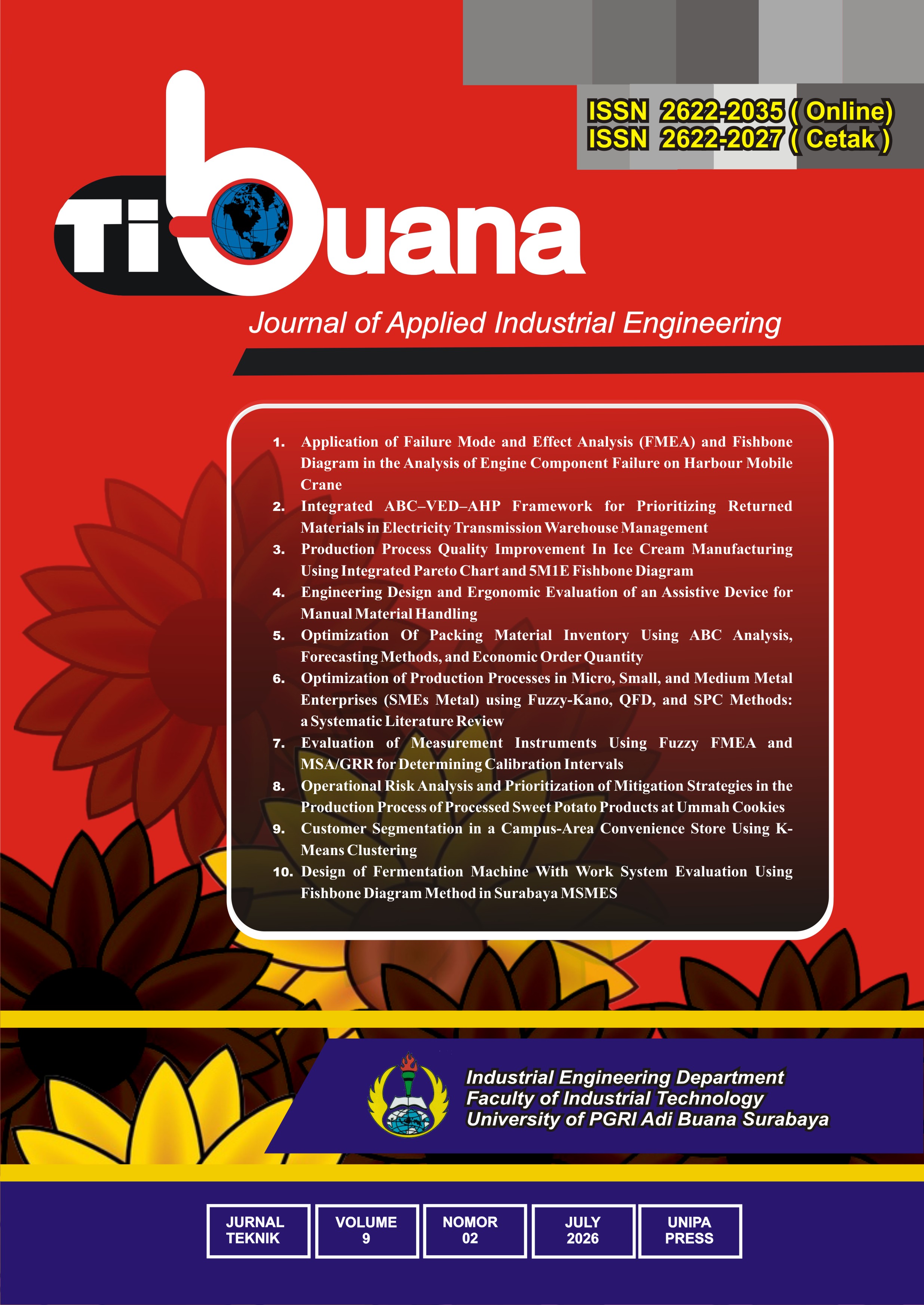
Operational Risk Analysis and Prioritization of Mitigation Strategies in the Production Process of Processed Sweet Potato Products at Ummah Cookies
DOI:
https://doi.org/10.36456/tibuana.9.02.11518Keywords:
AHP, FMEA, local food, risk mitigation.Abstract
The development of the local food industry in Indonesia faces challenges due to the increasing dominance of modern and imported food products, which have caused local food-based processed products to be increasingly marginalized. Ummah Cookies, as a local food processing MSME based on sweet potatoes and cassava, still faces various operational risks that have the potential to affect product quality and the stability of the production process. This study aims to analyze operational risks and determine risk mitigation strategies in the production process of sweet potato processed products at Ummah Cookies. The method used in this study is a combination of Failure Mode and Effects Analysis (FMEA) and Analytical Hierarchy Process (AHP). The FMEA method is used to identify and prioritize risks based on Severity, Occurrence, and Detection values through the calculation of the Risk Priority Number (RPN), while the AHP method is used to determine the priority of risk mitigation strategies. The results of the study showed that the highest risk in sweet potato brownies products was at the production stage in the form of the emergence of a strong sweet potato aroma with an RPN value of 330. Meanwhile, in sweet potato porridge products the highest risk was at the post-production stage in the form of products that spoil quickly during storage with an RPN value of 342. The results of the AHP analysis showed that the priority of risk mitigation in sweet potato brownies lies in the production aspect with an eigenvector value of 0.61, while in sweet potato porridge it lies in the post-production aspect with an eigenvector value of 0.49. Recommended risk mitigation strategies include controlling the quality of raw materials, controlling the temperature and cooking process, implementing production SOPs, and optimizing product storage and packaging systems. The implementation of these strategies is expected to be able to maintain product quality stability, increase production process efficiency, and minimize potential losses in local food MSMEs.
References
[1] M. Estiasih dan K. Ahmadi, Teknologi Pengolahan Pangan. Jakarta, Indonesia: Bumi Aksara, 2018.
[2] S. Widowati, “Pemanfaatan pangan lokal dalam mendukung ketahanan pangan nasional,” Jurnal Pangan, vol. 21, no. 1, pp. 1–10, 2019.
[3] A. Widianarko, “Tren konsumsi pangan sehat dan peluang pengembangan UMKM pangan lokal di Indonesia,” Jurnal Teknologi dan Industri Pangan, vol. 31, no. 2, pp. 120–128, 2020.
[4] R. Nurhayati dan D. Prasetyo, “Diversifikasi produk olahan ubi jalar sebagai upaya peningkatan nilai tambah komoditas lokal,” Jurnal Agroindustri Indonesia, vol. 9, no. 1, pp. 45–53, 2021.
[5] S. Widowati, “Diversifikasi konsumsi pangan berbasis pangan lokal,” Jurnal Pangan, vol. 20, no. 1, pp. 45–56, 2018.
[6] A. Winarno, “Strategi pengembangan produk pangan lokal dalam meningkatkan daya saing UMKM,” Jurnal Teknologi dan Industri Pangan, vol. 30, no. 2, pp. 110–118, 2020.
[7] R. Nurhayati dan D. Prasetyo, “Pengembangan usaha pangan lokal berbasis komoditas ubi dan singkong pada UMKM,” Jurnal Agroindustri Indonesia, vol. 9, no. 1, pp. 40–49, 2021.
[8] A. Pujawan dan E. Mahendrawathi, Supply Chain Management, 3rd ed. Yogyakarta, Indonesia: Andi, 2017.
[9] I. N. Pujawan, “Supply chain risk management,” Jurnal Teknik Industri, vol. 10, no. 1, pp. 1–8, 2019.
[10] R. Y. Yuniarti, “Analisis risiko operasional pada industri pangan UMKM menggunakan metode FMEA,” Jurnal Teknik Industri, vol. 12, no. 2, pp. 101–110, 2021.
[11] R. Y. Yuniarti, “Analisis risiko operasional pada industri pangan UMKM menggunakan metode FMEA,” Jurnal Teknik Industri, vol. 12, no. 2, pp. 101–110, 2021.
[12] H. A. Stamatis, Failure Mode and Effect Analysis: FMEA from Theory to Execution, 2nd ed. Milwaukee, WI, USA: ASQ Quality Press, 2003.
[13] M. D. Prasetiyo, I. Santoso, S. A. Mustaniroh, dan Purwadi, “Penerapan Metode FMEA dan AHP dalam Perumusan Strategi Pengelolaan Risiko Proses Produksi Yoghurt,” Jurnal Teknologi Pertanian, vol. 18, no. 1, pp. 1–10, 2017.
[14] O. Riana dan A. K. Al Ghofari, “Analisis Risiko Produksi menggunakan Metode Fuzzy Failure Modes and Effects Analysis (FMEA) dan Fuzzy Analytical Hierarchy Process (AHP) (Studi Kasus: UMKM Makaroni Keju Elfath),” Prosiding Simposium Nasional Rekayasa Aplikasi Perancangan dan Industri, pp. 120–128, 2024.
[15] E. A. Winanto dan I. Santoso, “Integrasi Metode Fuzzy FMEA dan AHP dalam Analisis dan Mitigasi Risiko Rantai Pasok Bawang Merah,” Jurnal Teknologi & Industri Hasil Pertanian, vol. 22, no. 1, pp. 21–32, 2017.
[16] D. H. Stamatis, Failure Mode and Effect Analysis: FMEA from Theory to Execution, 2nd ed. Milwaukee, WI, USA: ASQ Quality Press, 2003.
[17] H.-C. Liu, L. Liu, and N. Liu, “Risk evaluation approaches in failure mode and effects analysis: A literature review,” Expert Systems with Applications, vol. 40, no. 2, pp. 828–838, 2013.
[18] A. C. Kutlu and M. Ekmekçioğlu, “Fuzzy failure modes and effects analysis by using fuzzy TOPSIS-based fuzzy AHP,” Expert Systems with Applications, vol. 39, no. 1, pp. 61–67, 2012.
[19] E. Triantaphyllou and S. H. Mann, “Using the analytic hierarchy process for decision making in engineering applications: Some challenges,” International Journal of Industrial Engineering, vol. 2, no. 1, pp. 35–44, 1995.
[20] V. K. Chopra and R. Meindl, Supply Chain Management: Strategy, Planning, and Operation, 6th ed. Boston, MA, USA: Pearson, 2016.
[21] O. S. Vaidya and S. Kumar, “Analytic hierarchy process: An overview of applications,” European Journal of Operational Research, vol. 169, no. 1, pp. 1–29, 2006.
Downloads
Published
Issue
Section
License
Copyright (c) 2026 Tibuana : Journal of Applied Industrial Engineering

This work is licensed under a Creative Commons Attribution-ShareAlike 4.0 International License.