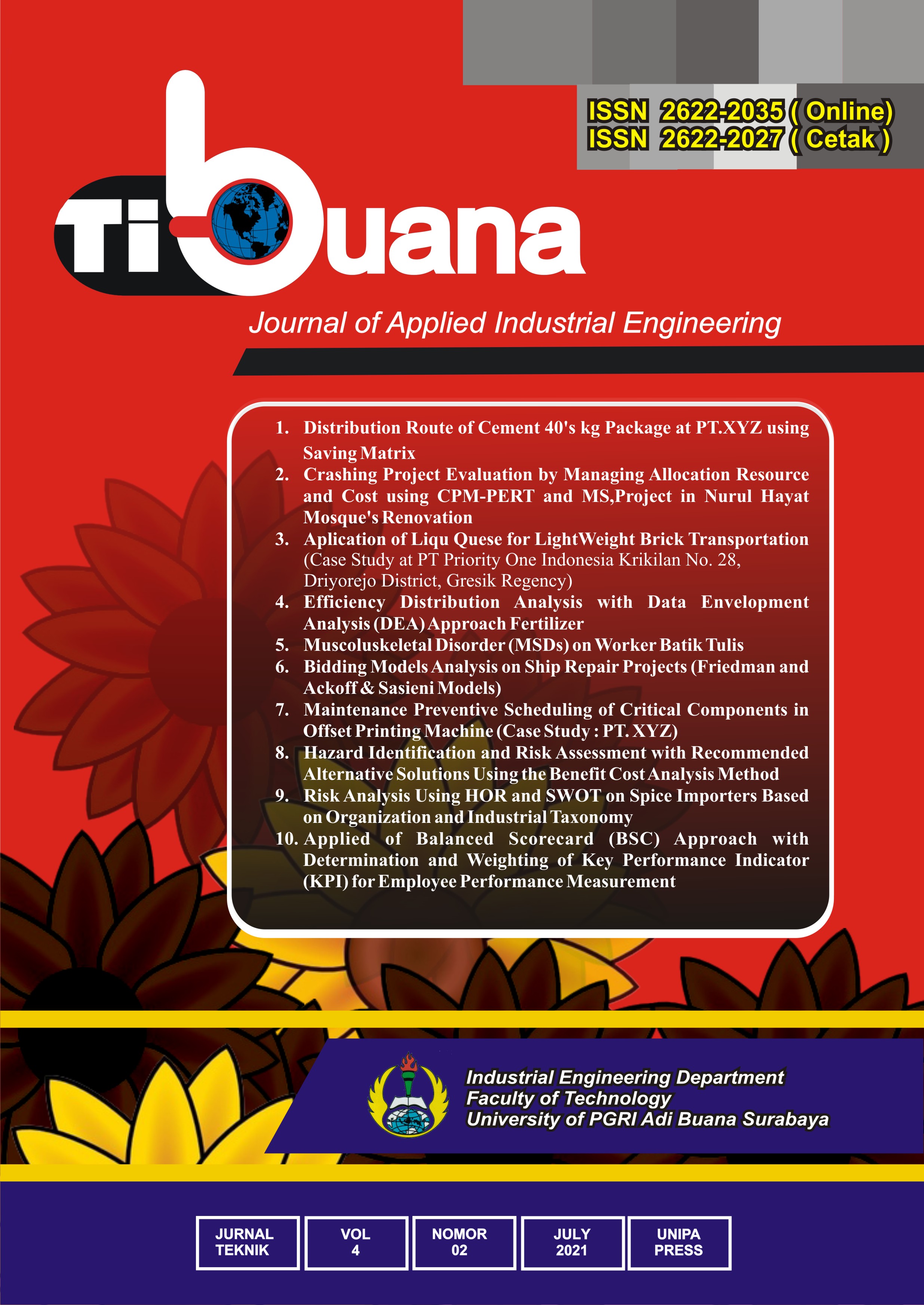
Efficiency Distribution Analysis with Data Envelopment Analysis (DEA) Approach Fertilizer
DOI:
https://doi.org/10.36456/tibuana.4.02.4010.91-98Keywords:
Efficiency level, distribution channel, salesAbstract
Distribution channels have an important meaning for achieving company success in the field of marketing so that company management is required to always be responsive and able to adapt to environmental changes. Input and output data processing is done by giving weights to the input and output using the DEA CCR primal model by maximizing the input-oriented-based objective function. The results of processing the efficiency scale show the relative efficiency level of the scale of each DMU in the company. The efficiency scale is obtained through the formulation of the DEA CCR primal model between each DMU input and output. If the DMU gets an input and output efficiency value of less than 100%, then the DMU is said to be relatively inefficient. Meanwhile, if the efficient value is equal to 100%, then the DMU is said to be relatively efficient. Of the 5 distribution cities, Sidoarjo, PaluKendari, Bandung and Lamongan which were analyzed, there were 2 cities that were inefficient or experiencing waste in their input and output variables, so the company needed to reorganize the level of use of inputs and outputs it achieved and utilize them optimally to get output that is optimal. targeted.
References
Andrew Firando, NugrohoPriyoNegorodanAangKunaifi, 20017, “Penerapan Data Envelopment AnalisysDalamPengukuranEfisiensi Retailer ProdukKendaraanMerek Toyota”. JurusanManajemenBisnisFakultasTeknologiIndustri, InstitutTeknologiSepuluh November (ITS).
Arikunto, S. 2006. “ProsedurPenelitianSuatuPendekatanPraktik”. Jakarta: J, RinekaCipta.
Bowlin,William F, 1998, "Measuring Performance: An Introduction to DataEnvelopment
Analysis (DEA)" Departement of Accounting University of Northen Iowa.
DjaslimSalidindanYevisMartieOesman, 2002, “IntisariPemasaran Dan UnsurUnsurPemasaran”. Bandung: Linda Karya
DjokoAdiWalujo, TitiekKoesdijati, YitnoUtomo (2019), PengendalianKualitas, Surabaya :
Scopindo
Hadad, Muliaman D., WimbohSantoso, Daniel Ilyas& EugeniaMardanugraha, 2003. “AnalisisEfisiensiIndustriPerbankan Indonesia MenggunakanMetodeNonparametrik Data EnvelomentAnalisys”.Working Paper Bank Indonesia
Indah Pertiwi, RatnantoFitriadi, Rika TriatiHapsari, 2007. “AnalisaDistribusiProdukDenganMenggunakanPendekatanSupplay Chain Management”.JurusanTeknikIndustriUniversitasMuhammadiyah Surakarta.
Mikael Hang Suryanto, SE.,M.M, 2016, “SistemOperasionalManajemenDistribusi”. Jakarta: Grasindo
Prof. Dr. Sugiyono, 2010. “MetodelogiPenelitianKuantitatif, Kualitatif, dan R&D”. Bandung: Alfabeta
Suseno Budi Prasetyo, 2008, “AnalisisEfisiensiDistribusiPemasaranProdukDenganMetode Data Envelopment Analisys (DEA)”. JurusanTeknikIndustri, FakultasTeknologiIndustri UPN V JawaTimur.
Swastha, Basu, Pro. Dr. MBA. 1990. “SaluranPemasaran, Jilid 1”. Yogyakarta: BPFE UGM
T Koesdijati (2017), “StrategiKorporasi”, Surabaya Adibuana (unipress)
UmiNarimawati, 2008, “MotodePenelitianKualitatifdanKuantitatifTeoridanAplikasi”. Bandung: Agung Media
YD Nurcahyanie, T Koesdijati (2019), Tools Method (Case Study: Pt. Njmx Surabaya),
Tibuana 3 (01), 53-60