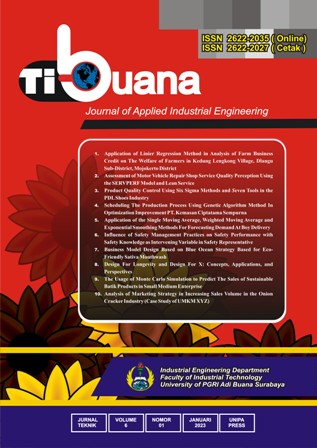
Assessment of Motor Vehicle Repair Shop Service Quality Perception Using the SERVPERF Model and Lean Service
DOI:
https://doi.org/10.36456/tibuana.6.1.6455.7-11Keywords:
Customer Satisfaction; Service Performance (SERVPERF); Lean Service MethodAbstract
The benchmark for the success of a business or product is to measure the satisfaction of customers who have used or felt the goods or services. The customer's expectations of the function and emotional happiness factors that arise from the use of goods or services are entirely the responsibility of the producer. So that manufacturers need to focus on what attributes must be presented in a product or service to increase customer satisfaction. The decrease in customer interest in providing vehicle service at an automotive company in Sidoarjo is the problem studied in this study, to analyze the level of customer satisfaction and attributes that are priority improvements as recommendations for the company.
Data generated from customers is processed and analyzed using the Service Performance (SERVPERF) and Lean Service methods. Based on the results of data processing, it can be concluded that the level of customer satisfaction with service quality is 82.3%, and three service attributes are classified as a top priority and two types of critical waste.
References
Aghajanzadeh, M., Aghabayk, K., Esmailpour, J., & De Gruyter, C. (2022). Importance – Performance Analysis (IPA) of metro service attributes during the COVID-19 pandemic. Case Studies on Transport Policy, 10(3), 1661–1672. DOI: https://doi.org/10.1016/j.cstp.2022.06.005
Bandi, V., Sahrakorpi, T., Paatero, J., & Lahdelma, R. (2022). The paradox of mini-grid business models: A conflict between business viability and customer affordability in rural India. Energy Research and Social Science, 89(January), 102535. DOI: https://doi.org/10.1016/j.erss.2022.102535
Belwal, R., & Amireh, M. (2018). Service quality and attitudinal loyalty: Consumers’ perception of two major telecommunication companies in Oman. Arab Economic and Business Journal, 13(2), 197–208. DOI: https://doi.org/10.1016/j.aebj.2018.11.003
Ito, A., Hagström, M., Bokrantz, J., Skoogh, A., Nawcki, M., Gandhi, K., Bergsjö, D., & Bärring, M. (2022). Improved root cause analysis supporting resilient production systems. Journal of Manufacturing Systems, 64(August), 468–478. 5 DOI: https://doi.org/10.1016/j.jmsy.2022.07.015
Johnson, J., & Scott, M. (2022). Service users evaluation of outpatient NHS physiotherapy services. Using SERVPERF and IPA tools for transforming provision. Physiotherapy, 114, e229. DOI: https://doi.org/10.1016/j.physio.2021.12.220
Klein, L. L., Tonetto, M. S., Avila, L. V., & Moreira, R. (2021). Management of lean waste in a public higher education institution. Journal of Cleaner Production, 286, 125386. DOI: https://doi.org/10.1016/j.jclepro.2020.125386
Novák, A., Sedlácková, A. N., Bugaj, M., Kandera, B., & Lusiak, T. (2020). Use of unmanned aerial vehicles in aircraft maintenance. Transportation Research Procedia, 51(2019), 160–170. DOI: https://doi.org/10.1016/j.trpro.2020.11.018
Ozden, A. T., & Celik, E. (2021). Analyzing the service quality priorities in cargo transportation before and during the Covid-19 outbreak. Transport Policy, 108(April), 34–46. DOI: https://doi.org/10.1016/j.tranpol.2021.04.025
Prohl-Schwenke, K., & Kleinaltenkamp, M. (2021). How business customers judge customer success management. Industrial Marketing Management, 96(May), 197–212. DOI: https://doi.org/10.1016/j.indmarman.2021.05.004
Pudāne, B., Rataj, M., Molin, E. J. E., Mouter, N., van Cranenburgh, S., & Chorus, C. G. (2019). How will automated vehicles shape users’ daily activities? Insights from focus groups with commuters in the Netherlands. Transportation Research Part D: Transport and Environment, 71(June), 222–235. DOI: https://doi.org/10.1016/j.trd.2018.11.014
Rajab, S., Afy-Shararah, M., & Salonitis, K. (2022). Using Industry 4.0 Capabilities for Identifying and Eliminating Lean Wastes. Procedia CIRP, 107(2021), 21–27. DOI: https://doi.org/10.1016/j.procir.2022.04.004
Roh, T., Park, B. Il, & Xiao, S. (Simon). (2022). Multiple principal conflicts and technological innovation performances of international new ventures: Moderating role of founder’s experiences. Journal of Innovation & Knowledge, 7(4), 100274. DOI: https://doi.org/10.1016/j.jik.2022.100274
Ruan, Y., & Mezei, J. (2022). When do AI chatbots lead to higher customer satisfaction than human frontline employees in online shopping assistance? Considering product attribute type. Journal of Retailing and Consumer Services, 68(March). DOI: https://doi.org/10.1016/j.jretconser.2022.103059
Salamah, A. A., Hassan, S., Aljaafreh, A., Zabadi, W. A., AlQudah, M. A., Hayat, N., Al Mamun, A., & Kanesan, T. (2022). Customer retention through service quality and satisfaction: using hybrid SEM-neural network analysis approach. Heliyon, 8(9), e10570. DOI: https://doi.org/10.1016/j.heliyon.2022.e10570
Steckowych, K., & Smith, M. (2019). Primary care workflow process mapping of medication-related activities performed by non-provider staff: A pilot project’s approach. Research in Social and Administrative Pharmacy, 15(9), 1107–1117. DOI: https://doi.org/10.1016/j.sapharm.2018.09.014
Steinhoff, L., & Zondag, M. M. (2021). Loyalty programs as travel companions: Complementary service features across customer journey stages. Journal of Business Research, 129(October 2019), 70–82. DOI: https://doi.org/10.1016/j.jbusres.2021.02.016
Sun, X., Cao, S., & Tang, P. (2021). Shaping driver-vehicle interaction in autonomous vehicles: How the new in-vehicle systems match the human needs. Applied Ergonomics, 90(November 2019), 103238. DOI: https://doi.org/10.1016/j.apergo.2020.103238
Sürücü, Ö., Öztürk, Y., Okumus, F., & Bilgihan, A. (2019). Brand awareness, image, physical quality and employee behavior as building blocks of customer-based brand equity: Consequences in the hotel context. Journal of Hospitality and Tourism Management, 40(November 2018), 114–124. DOI: https://doi.org/10.1016/j.jhtm.2019.07.002
Suryadi, A., Islami, M. C. P. A. ., Taufiq, S. I., & Santoso, B. (2021). Company Quality Performance Using Customer Satisfaction Index Methods and Importance Performance Analysis at PT. XYZ. 2021(2020), 244–250.
Tadesse, B., & Bakala, F. (2021). Effects of automated teller machine service on client satisfaction in Commercial Bank of Ethiopia. Heliyon, 7(3), e06405. DOI: https://doi.org/10.1016/j.heliyon.2021.e06405
Woo, H., Kim, S. J., & Wang, H. (2021). Understanding the role of service innovation behavior on business customer performance and loyalty. Industrial Marketing Management, 93(April 2019), 41–51. DOI: https://doi.org/10.1016/j.indmarman.2020.12.011
Downloads
Published
Issue
Section
License
Copyright (c) 2023 Tibuana

This work is licensed under a Creative Commons Attribution-ShareAlike 4.0 International License.