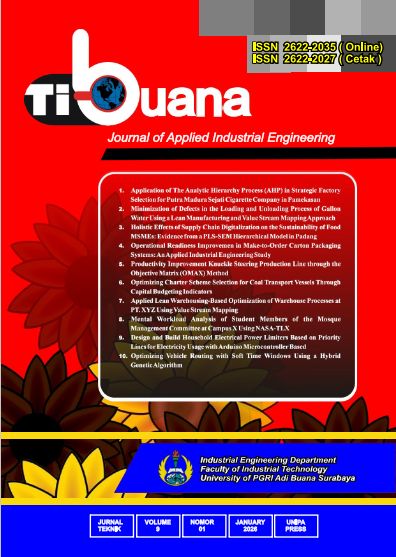
Mental Workload Analysis of Student Members of the Mosque Management Committee at Campus X Using NASA-TLX
DOI:
https://doi.org/10.36456/tibuana.9.1.10911Keywords:
Mental Workload, NASA-TLX, Organization, StudentsAbstract
Students who serve as administrators of campus mosques often face dual responsibilities: fulfilling academic obligations while simultaneously managing various religious activities on campus. Balancing these roles can lead to a considerable mental workload. This study aims to assess the level of mental burden experienced by students actively involved as campus mosque administrators. The research was conducted at a university mosque located in Yogyakarta. Mental workload was measured using the NASA-TLX instrument, which evaluates six key dimensions of cognitive load. Findings revealed an average mental workload score of 71.14, categorized as high. A total of 80% of participants reported experiencing high to very high levels of mental stress. The most prominent contributing dimensions were mental demand, effort, and perceived performance. These results highlight the need for effective workload management strategies, including equitable task distribution, engagement of external volunteers, stress and time management training, and promoting awareness of the importance of balancing academic and organizational commitments.
References
[1] V. R. Ariani, S. Suwartiningsih, and A. W. Utomo, “Dinamika Interaksi Sosial (Studi Kasus Mahasiswa Pegunungan Bintang di Universitas Kristen Satya Wacana Salatiga),” INNOVATIVE: Journal Of Social Science Research, vol. 4, no. 4, Jul. 2024, Accessed: Jul. 09, 2025. [Online]. Available: https://j-innovative.org/index.php/Innovative/article/view/9052
[2] E. K. Making, F. Tuffahati, and R. F. Baihaqqi, “Studi Kasus Mengenai Strategi Belajar Pada Mahasiswa Yang Aktif Dalam Organisasi BEM FIS UNJ,” Jurnal Bintang Pendidikan Indonesia, vol. 1, no. 3, pp. 47–56, Jun. 2023, doi: 10.55606/jubpi.v1i3.1603.
[3] S. Yolanda, S. M. Sari, and I. Ismail, “Peran Organisasi Mahasiswa Dalam Membangun Karakter Kepemimpinan Dan Peningkatan Soft Skill,” Pendas : Jurnal Ilmiah Pendidikan Dasar, vol. 9, no. 4, 2024.
[4] Isan, Ibnu As’ad Rosyidin, and N. Nuryanta, “Peran Masjid Sekitar Kampus Sebagai Upaya Mensinergikan Antara Masyarakat Dengan Lingkungan Pendidikan: Studi Kasus Di Masjid Al Mukmin Plosorejo,” At-Thullab : Jurnal Mahasiswa Studi Islam, vol. 6, no. 2, pp. 1664–1671, Nov. 2024, doi: 10.20885/tullab.vol6.iss2.art3.
[5] S. Saridudin, “PEMBERDAYAAN JAMAAH MELALUI PENDIDIKAN LIFE SKILLS PADA MASJID AL-ANWAR GONDANG WONOSOBO,” Penamas, vol. 34, no. 1, pp. 23–42, Jun. 2021, doi: 10.31330/penamas.v34i1.396.
[6] A. Arsam, S. Nurmahyati, and A. Amaluddin, “Manajemen Dakwah Takmir Masjid Jogokaryan dalam Membangun Peradaban Islam di Mantrijeron Yogyakarta,” Tadbir: Jurnal Manajemen Dakwah, vol. 9, no. 1, pp. 19–40, May 2024, doi: 10.15575/tadbir.v9i1.33885.
[7] A. Arwanda and M. A. Pramana, “Takmir Masjid dan Otoritasnya: Pengelolaan Masjid di Pekanbaru,” Idarotuna, vol. 5, no. 2, pp. 114–125, Oct. 2023, doi: 10.24014/idarotuna.v5i2.22880.
[8] S. Maisaroh, I. Ismail, and P. Korespondensi, “Pengaruh Kompetensi dan Self Efficacy Terhadap Kinerja Takmir Kecamatan Pakong,” Jurnal Kajian Ilmu Manajemen, vol. 3, no. 2, pp. 210–218, 2023, [Online]. Available: https://journal.trunojoyo.ac.id/jkim
[9] M. R. Yulizar, N. Mubarak, Saputra, and S. Komalasari, “Apakah Mahasiswa Aktif Berorganisasi Lebih Dari Satu Mengakibatkan Prokrastinasi Akademik?,” Empowerment, vol. 5, no. 1, 2025.
[10] S. V. Peristianto and R. Widyana, “Organizational involvement, academic procrastination, and emotional exhaustion in college students,” Insight: Jurnal Ilmiah Psikologi, vol. 27, no. 1, pp. 15–29, 2025, doi: 10.26486/psikologi.v27i1.4008.
[11] H. Kuswanto, “The Impact of Academic Stress on Psychological Well-Being with Life-College Balance as a Moderating Variable for Students in Jakarta,” Jurnal Indonesia Sosial Saind, vol. 6, no. 1, pp. 260–265, Feb. 2025, doi: https://doi.org/10.59141/jiss.v6i1.1597.
[12] H. A. Casya, Suliawati, and B. Harahap, “Analisis Beban Kerja Mental Mahasiswa Tingkat Akhir Pada Penyelesaian Tugas Akhir Menggunakan Metode Nasa-TLX,” Buletin Utama Teknik, vol. 20, no. 1, pp. 55–60, 2024.
[13] R. A. Hidayati and A. S. Basyari, “Pengukuran Beban Kerja Mental Mahasiswa Pekerja Fakultas Ekonomi Dan Bisnis Universitas Muhammadiyah Gresik Menggunakan Metode Nasa-TLX,” Jurnal Manajerial, vol. 11, no. 03, p. 356, Sep. 2024, doi: 10.30587/jurnalmanajerial.v11i03.7700.
[14] W. Li, R. Li, X. Xie, and Y. Chang, “Evaluating mental workload during multitasking in simulated flight,” Brain Behav, vol. 12, no. 4, Apr. 2022, doi: 10.1002/brb3.2489.
[15] F. N. Rahman and A. Y. Pratama, “Analisis Beban Kerja Mental Pekerja Train Distribution PT. Solusi Bangun Indonesia,” Jurnal Teknologi dan Manajemen Industri Terapan / JTMIT, vol. 1, no. 1, pp. 7–14, Mar. 2022.
[16] M. Alfani, “Analisis Beban Kerja Mental Pada Kepala Pasar X Dengan Metode Nasa-TLX,” Profisiensi, vol. 11, no. 1, pp. 60–67, Jul. 2023, doi: 10.33373/profis.v11i1.5315.
[17] A. Nisa’ and W. Widyastuti, “The Relationship Between Job Demands and Self-Efficacy on Academic Stress Levels in Working Students in Sidoarjo City,” Academia Open, vol. 10, no. 1, pp. 6–17, Jun. 2025, doi: 10.21070/acopen.10.2025.11141.
Downloads
Published
Issue
Section
License
Copyright (c) 2026 Tibuana : Journal of Applied Industrial Engineering

This work is licensed under a Creative Commons Attribution-ShareAlike 4.0 International License.