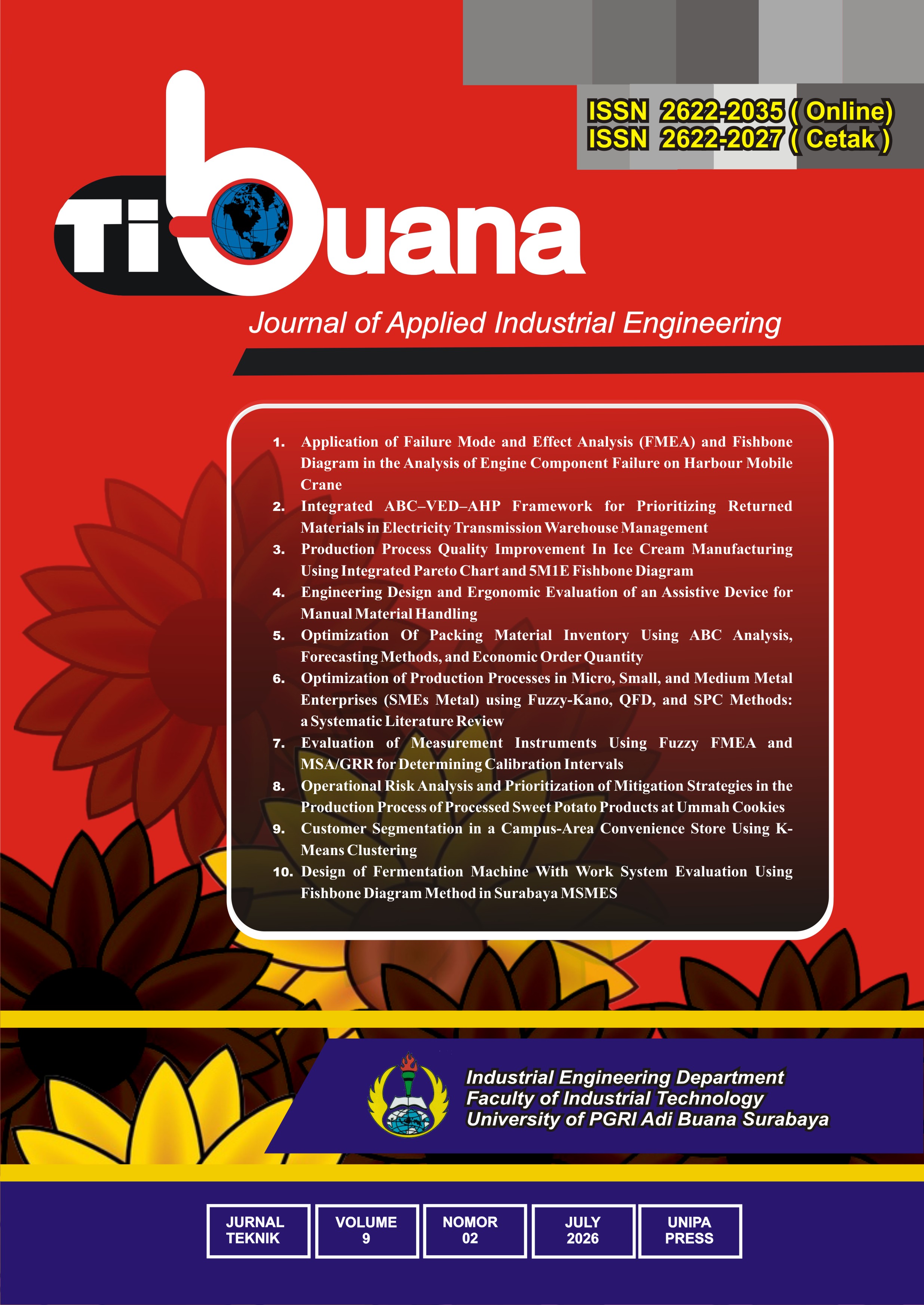
Customer Segmentation in a Campus-Area Convenience Store Using K-Means Clustering
DOI:
https://doi.org/10.36456/tibuana.9.02.11641Keywords:
Customer Segmentation, K-Means Clustering, Convenience Store, Consumer BehaviorAbstract
Customer segmentation is an important strategy for understanding differences in customer characteristics and supporting more targeted marketing decisions. In campus areas, convenience store customers generally consist of students with diverse demographic, economic, and accessibility characteristics, resulting in different purchasing behaviors. This study aims to identify customer segments of a convenience store located in the Campus X area of Yogyakarta using the K-Means Clustering algorithm. The study employed a quantitative approach with data mining techniques using customer data from students. The variables analyzed included age, income, shopping intensity, and residential distance from the store. The optimal number of clusters was determined using the Elbow Method before applying the K-Means algorithm. The results identified three customer segments with distinct characteristics. The largest segment consisted of customers living relatively close to the store and exhibiting high shopping intensity, while another segment was characterized by lower purchasing activity and greater residential distance. The smallest segment showed the highest income level and more diverse product preferences. Furthermore, differences in customer characteristics were reflected in product purchasing patterns across the identified segments. These findings indicate that accessibility and economic factors play important roles in shaping customer purchasing behavior in campus-area convenience stores. The results can serve as a reference for developing more targeted promotional and product management strategies.References
[1] M. Devinta, N. Hidayah, and G. Hendrastomo, “Fenomena Culture Shock (Gegar Budaya) Pada Mahasiswa Perantauan di Yogyakarta,” E-Societas: Jurnal Pendidikan Sosiologi, vol. 5, no. 3, pp. 1–15, 2016, doi: 10.21831/e-societas.v5i3.3946.
[2] T. A. Widyadhana et al., “Analisis Perilaku dan Preferensi Mahasiswa terhadap Pengalaman Belanja Online dan Offline,” PAJAMKEU: Pajak dan Manajemen Keuangan, vol. 1, no. 2, pp. 01–13, 2024, doi: https://doi.org/10.61132/pajamkeu.v1i2.77.
[3] A. N. Auliya and H. Hartini, “PENGARUH SALES PROMOTION, STORE ATMOSPHERE DAN KEPRIBADIAN KONSUMEN TERHADAP IMPULSE BUYING PADA KONSUMEN ALFAMART DI KECAMATAN SUMBAWA,” Jurnal Nusa Manajemen, vol. 3, no. 1, pp. 11–26, 2026, doi: doi.org/10.62237/jnm.v3i1.386.
[4] F. Lakuy and Y. Sopacua, “Antara Harga, Promosi, dan Gaya Hidup: Faktor-Faktor Pembentuk Perilaku Konsumtif Mahasiswa di Era Marketplace Digital,” Populis: Jurnal Ilmu Sosial dan Ilmu Politik, vol. 19, no. 2, pp. 170–184, May 2025, doi: 10.30598/populis.19.2.170-184.
[5] R. Pangesti, S. Z. Aliah, N. Nazela, V. V. Sununianti, I. Istiqomah, and D. A. Kurniawan, “Budaya Konsumtif Mahasiswa dalam Mengikuti Tren: Analisis Perspektif Karl Max,” RISOMA : Jurnal Riset Sosial Humaniora dan Pendidikan, vol. 4, no. 3, pp. 275–266, May 2026, doi: 10.62383/risoma.v4i3.1690.
[6] S. Hidajat and W. T. Wardhana, “Pengaruh Literasi Keuangan dan Sikap Keuangan Terhadap Pengelolaan Keuangan Mahasiswa,” Journal of Economics and Business UBS, vol. 12, no. 2, pp. 1036–1048, 2023, doi: doi.org/10.52644/joeb.v12i2.200.
[7] H. Holil, N. Susanti, and R. T. Yanti, “The Influence of Price, Location and Service on Purchase Decisions at the Air Sebakul NRL Minimarket, Bengkulu City,” Jurnal Fokus Manajemen, vol. 1, no. 2, pp. 48–54, 2021, doi: https://doi.org/10.37676/jfm.v1i2.1880.
[8] D. D. Eisenring, “PERTUMBUHAN AREA PERKOTAAN 2 DI SEKITAR KAMPUS PERGURUAN TINGGI UNIVERSITAS TADULAKO PALU,” RUANG : JURNAL ARSITEKTUR, vol. 16, no. 1, pp. 39–50, 2022, doi: https://doi.org/10.22487/ruang.v16i1%20Maret.42.
[9] C. C. Ishano, N. Adiarni, and M. Najamuddin, “SEGMENTASI PASAR KONSUMEN MAKANAN DI JAKARTA, INDONESIA DENGAN PENDEKATAN FOOD-RELATED LIFESTYLE,” AGRIBUSINESS JOURNAL, vol. 10, no. 2, pp. 149–166, 2016, doi: doi.org/10.15408/aj.v10i1.9228.
[10] A. W. A. Wibowo, “Analisis Klaster Perilaku Konsumen Produk Mocaf Menggunakan K-Means Clustering,” JABis: Jurnal Administrasi Bisnis, vol. 23, no. 1, pp. 1–15, 2025.
[11] K. M. Chelviani, M. A. Meitriana, and I. A. Haris, “ANALISIS FAKTOR-FAKTOR YANG MEMPENGARUHI PEMILIHAN LOKASI TOKO MODERN DI KECAMATAN BULELENG,” Jurnal Pendidikan Ekonomi Undiksha, vol. 9, no. 2, pp. 257–266, 2019, doi: https://doi.org/10.23887/jjpe.v9i2.20051.
[12] M. Norshahlan, H. Jaya, and R. Kustini, “Penerapan Metode Clustering Dengan Algoritma K-means Pada Pengelompokan Data Calon Siswa Baru,” JURSI TGD : Jurnal Sistem Informasi Triguna Dharma, vol. 2, no. 6, pp. 1042–1053, 2023, doi: https://doi.org/10.53513/jursi.v2i6.9148.
[13] S. Sindrawati, D. Syaripudin, and A. R. Raharja, “PENERAPAN ALGORITMA K-MEANS CLUSTERING PADA DATA NILAI SISWA UNTUK MENENTUKAN KELOMPOK PENERIMA BEASISWA,” SISINFO : Jurnal Sistem Informasi Dan Informatika, vol. 6, no. 2, pp. 47–52, 2024, doi: https://doi.org/10.37278/sisinfo.v6i2.900.
Downloads
Published
Issue
Section
License
Copyright (c) 2026 Tibuana : Journal of Applied Industrial Engineering

This work is licensed under a Creative Commons Attribution-ShareAlike 4.0 International License.