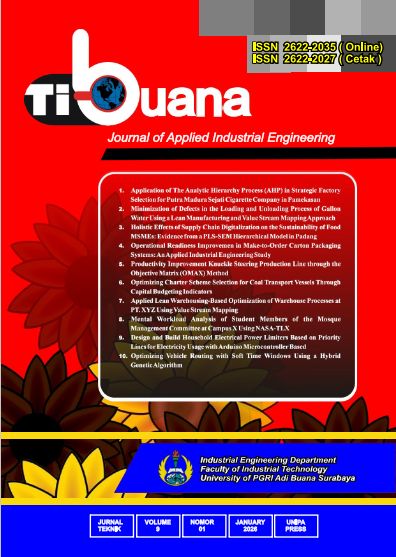
Applied Lean Warehousing-Based Optimization of Warehouse Processes at PT. XYZUsing Value Stream Mapping
DOI:
https://doi.org/10.36456/tibuana.9.1.11156Keywords:
Lean warehousing; Value stream mapping; Incoming warehouse; Process cycle efficiency; Lead time minimizationAbstract
Incoming warehouse operations are essential for maintaining material readiness in manufacturing systems. In practice, inefficiencies within these operations may increase lead time and generate activities that do not contribute to value creation. This study focuses on enhancing the performance of the incoming warehouse process at PT. XYZ through the application of lean warehousing supported by Value Stream Mapping (VSM). The study was carried out by examining the actual condition of receiving, recording, and storage activities using direct observation, time measurement, and process mapping. All identified activities were categorized according to their contribution to value creation. Process performance was assessed using Process Cycle Efficiency (PCE) to quantify the ratio of value-added time to total lead time. The results indicate that the existing incoming warehouse process required 296 minutes to complete, with a PCE of 74.66%, reflecting the presence of non-value-added activities, particularly related to waiting and unnecessary movement. Improvement actions were then formulated using future state value stream mapping and workplace organization. The proposed future condition reduced the total lead time to 273 minutes and increased the PCE to 80.95%. These findings show that lean warehousing implementation can effectively improve process efficiency by reducing non-value-added activities in incoming warehouse operations. The study provides practical insight for manufacturing companies seeking to improve inbound warehouse performance through structured waste reduction initiatives.
References
Adeodu, A., Maladzhi, R., Grace, M., & Katumba, K. (2023). Heliyon Development of an improvement framework for warehouse processes using lean six sigma ( DMAIC ) approach . A case of third party logistics ( 3PL ) services. Heliyon, 9(4), e14915. https://doi.org/10.1016/j.heliyon.2023.e14915
Afif, M. S. N., & Sudarto, S. (2022). Penerapan konsep lean untuk meningkatkan operasi warehouse di industri manufaktur ( Implementation of lean concept to improve warehouse operation in manufacturing industry ). Operations Excellence: Journal of Applied Industrial Engineering, 14(1), 57–66. https://doi.org/https://doi.org/10.22441/oe.2022.v14.i1.043
Ardysti, A. R., & Ernawati, D. (2025). Identifikasi Pemborosan Dengan Pendekatan Lean Warehouse Pada Gudang Oli di PT ABC. Briliant: Jurnal Riset Dan Konseptual, 10(3), 736–749.
Barry, H., Ella, Y., Chandra, N., Rachmanisa, F., Niaga, J. A., & Jakarta, P. N. (2023). Analisis Lean Warehouse untuk Meminimalisir Waste dan Dampaknya pada Proses Inbound Warehouse PT. Xyz. SNIV: SEMINAR NASIONAL INOVASI VOKASI, 2(1), 237–247.
Briones-chávez, A., Sandoval-soldevilla, N., & Quiroz-flores, J. C. (2025). Applying Lean Warehousing Tools to Improve OTIF : A Case Study in a Logistics SME in the Freight Transportation Sector in Peru. 12(1), 113–126.
Dzulkifli, F., & Ernawati, D. (2021). Analisa Penerapan Lean Warehousing Serta 5s Pada Pergudangan PT. Sier Untuk Meminimasi Pemborosan. Juminten : Jurnal Manajemen Industri Dan Teknologi, 02(03), 35–46.
Ikatrinasari, Z. F. (2023). Warehouse management analysis with value stream mapping and 5S to improve efficiency process productivity .
Julião, B. J. B., & Reis, M. S. (2025). A Systematic Lean-Driven Framework for Warehouse Optimization. Systems, 13(813), 1–31.
Mahen, R. A., Batubara, H., & Wijayanto, D. (2023). Identifikasi Waste Melalui Proces Activity Mapping Dan Pendekatan Lean Manufacturing Pada Cv. Kreatifika Harapan Terbang Abadi. INTEGRATE: Industrial Engineering and Management System, 7(2), 114–121. https://jurnal.untan.ac.id/index.php/jtinUNTAN/issue/view/2162
Nurulita, S. (2024). Analisis Penerapan Lean Warehouse untuk Minimasi Waste pada PT Pos Logistik Indonesia. Jurnal Logistics & Supply Chain (LOGIC), 03(01), 25–32. https://doi.org/https://doi.org/10.33197/jlscc.v3i1.2276
Pamungkas, C. A., & Aryanny, E. (2025). Analysis of waste in the flow process warehouse using the lean warehousing method : case in an animal feed company. Operations Excellence: Journal of Applied Industrial Engineering, 17(1), 119–132.
Purnomo, H., & Kien, P. T. (2025). Integrating Lean Warehousing and Systematic Analysis to Minimize Waste in Finished Product Storage : A Case Study and Generalizable Improvement Framework. Advance Sustainable Science, Engineering and Technology (ASSET), 8(1), 1–11.
Putra, W. I., & Widjajati, E. P. (2025). Penerapan Metode Lean Warehousing dalam Analisis Pemborosan pada Proses Aliran Pergudangan Wiedy. Ekonomis: Journal of Economics and Business, 09(02), 861–871. https://doi.org/10.33087/ekonomis.v9i2.1971
Ramadhanti, C., Pramestiana, I., & Nurulita, S. (2023). Analisis Penerapan Lean Warehouse Untuk Meminimalisir Waste Menggunakan Value Stream Mapping Dan Fishbone Diagram. Jurnal Ilmiah Teknologi Informasi Terapan (JITTER), 9(2), 190–196.
Shafalah, F., Permana, T., & Larutama, W. (2025). Optimalisasi Proses Inbound Melalui Penerapan Lean Logistics Di Warehouse Fmcg Pada PT DE. Jurnal Industri Dan Teknologi Samawa, 6(2), 215–223.
Downloads
Published
Issue
Section
License
Copyright (c) 2026 Tibuana : Journal of Applied Industrial Engineering

This work is licensed under a Creative Commons Attribution-ShareAlike 4.0 International License.